


DOING ECO confirmed an order in August 2026 with a Malaysian waste recycling customer for two DY-20 plastic pyrolysis machines. The customer operates in the waste recovery sector and placed the order to move beyond basic collection and into waste plastic pyrolysis — a process that converts plastic into fuel oil, carbon black, and combustible gas. The deciding factor was the profit margin of the end products compared with the customer's existing low-margin recycling work.
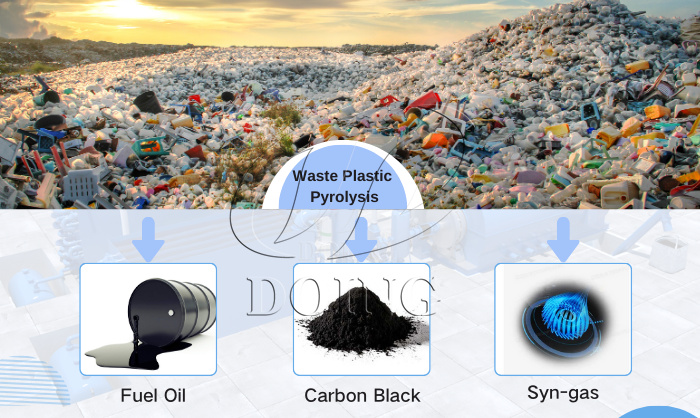
Products of plastic pyrolysis
The customer has worked in Malaysia's waste recycling industry, handling and reselling recovered materials. That business sits at the lower-value end of the waste chain: the operator earns a handling or resale fee but does not capture the material's downstream value. Pyrolysis changes the economics. Instead of selling unsorted or lightly processed plastic, the operator can process it into fuel oil that carries a clearer resale value, plus carbon black as a secondary byproduct. For Malaysia customer, two DY-20 pyrolysis machines provide enough daily capacity to turn plastic intake into a steady output of saleable products, shifting the business from "collect and pass on" to "collect and produce."
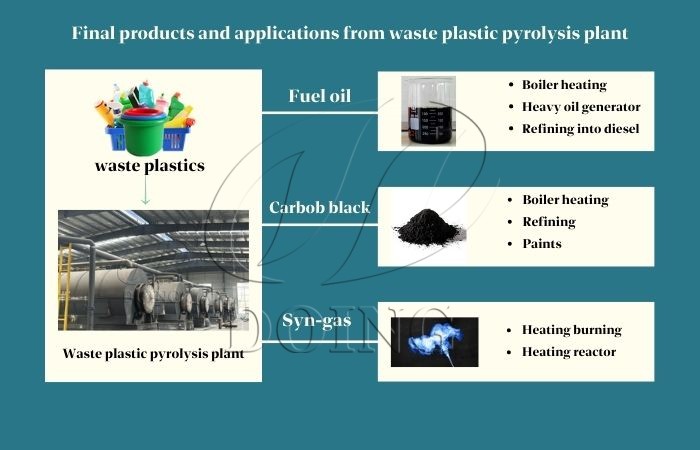
Final products and applications from waste plastic pyrolysis machine
The customer's interest in the DY-20 pyrolysis machine was not about processing volume alone but about output value. Waste plastic in its raw form has limited and volatile resale pricing. Once converted through pyrolysis, the same material becomes fuel oil — a product with established industrial demand as boiler or furnace fuel, and a base feedstock for further refining. Carbon black from the process is also tradable. Processing locally also reduces dependence on external resale channels. For a recycling operator, this margin gap is what makes the move from collection to production worth the equipment investment.
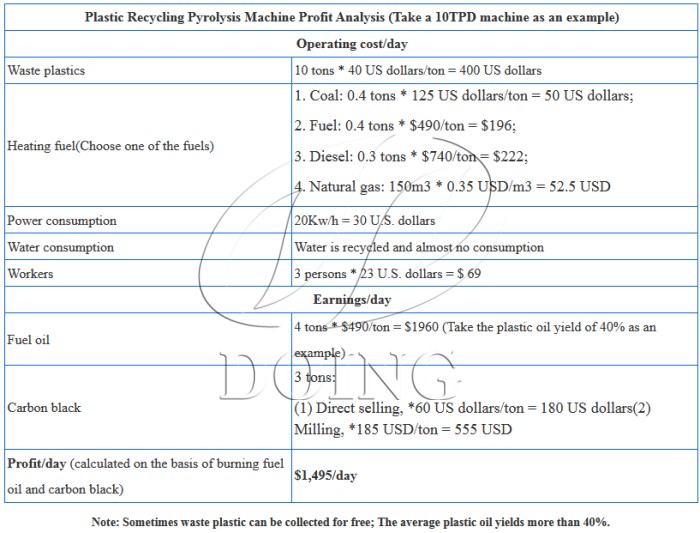
Plastic pyrolysis machine profit analysis
During the evaluation, the customer's main technical concern was the dewaxing process. Plastic pyrolysis — especially feedstock containing PE — produces wax that can clog condenser lines and lower oil fluidity. Wax in the final oil reduces its market value and complicates storage and pumping. For a customer whose whole case rests on product quality and resale, dewaxing was not a side issue; it was the condition that determined whether the equipment would actually pay back. An oil with high wax content is harder to store, pump, and sell, which directly erodes the margin advantage the customer was investing for.
The part of the design that mattered most to this customer was the dewaxing process. The DY-20 handles wax on two levels — reducing how much forms, and removing what still appears.
Reducing wax at the source. A catalyst is applied to the oil and gas stream ahead of cooling. It acts on the wax-forming components in the vapor, breaking them down before they can condense into solid wax in the oil. Less wax is produced in the first place, which is the most direct way to keep the final oil fluid and saleable.
Removing wax before the condenser. A dewaxing stage is built into the process route. Wax that does form is separated or treated before the vapor reaches the cooling lines, so it does not accumulate inside the condenser pipes. The design pairs this with a larger condenser path and keeps the oil lines warm through heating coils and insulation, so any remaining wax stays fluid instead of solidifying and blocking the system.
Routine cleaning as a safeguard. Because wax buildup is inherent to plastic pyrolysis, the DY-20 is laid out so wax-collecting points can be reached and cleaned during maintenance, stopping gradual blockage from affecting output or oil quality.
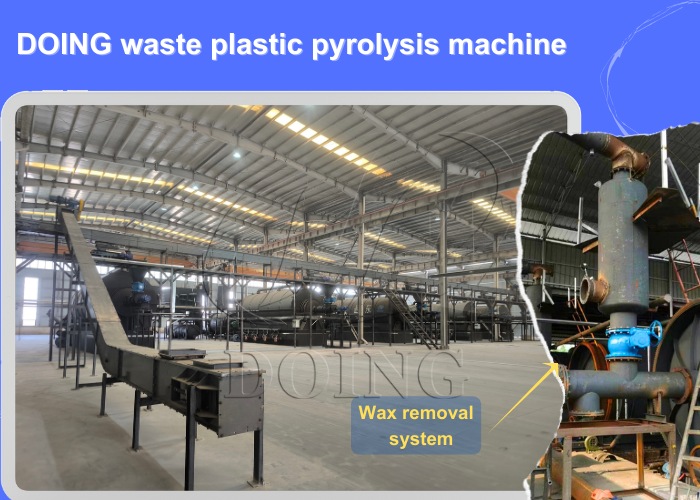
DOING ECO plastic pyrolysis machine wax removal system
The equipment supports the customer's business model on four points:
| Design point | How it serves the customer |
| Two DY-20 pyrolysis units | Capacity to process the customer's pe plastic intake at scale, daily waste plastic recycling capacity: 40Ton, anual capacity: over 13000 ton |
| Catalyst application | Reduces wax formation at the source, improves oil fluidity |
| Dewaxing stage before condenser | Stops wax reaching and clogging the cooling lines |
| Warm oil lines + larger condenser | Keeps residual wax fluid, avoids blockage |
| Output: fuel oil, carbon black | Saleable products that replace low-margin resale |
The customer visited DOING ECO's facility twice before ordering. Both trips focused on verifying the dewaxing process and catalyst application in practice — checking the process route, output oil samples, and run stability under different feedstock conditions. After the second visit, the customer confirmed the order in August 2026, specifying two DY-20 units.
The two DY-20 plastic pyrolysis machines have entered DOING ECO's production schedule and will be shipped to the customer's site in Malaysia per the agreed plan.

